Minting operations in 2001 continued the production of one-cent coins utilizing a zinc core covered with a thin layer of copper.
Compositional analysis reveals 97.5% zinc and 2.5% copper, applied via an electroplating method.
Mass measurements for a standard specimen amount to 2.5 grams, having a weight tolerance of 0.1 grams.
Diameter specifications equal 19.05 mm while employing a plain edge lacking any reeding.
Facilities in Philadelphia (no mint mark) and Denver (D) handled the primary coinage tasks.
A 2001 penny mintage figure in Philadelphia reached 4,959,600,000 pieces, whereas Denver produced 5,374,990,000 coins.

San Francisco manufactured 3,184,452 specimens in Proof quality intended for annual collector sets.
High coin availability in circulation decades later stems from a total output exceeding 10.3 billion units.
Grade | 2001 (P) RD | 2001-D RD | 2001-S Proof |
MS65 | $0.10 – $0.50 | $0.10 – $0.50 | $2.00 |
MS66 | $5.00 – $12.00 | $5.00 – $10.00 | $5.00 |
MS67 | $15.00 – $35.00 | $12.00 – $30.00 | $10.00 |
MS68 | $150.00 – $450.00 | $85.00 – $250.00 | $35.00 |
MS69 | $4,000.00+ | $500.00+ | $250.00 (PR70) |
Specimens in MS69 RD condition represent an exceptional rarity resulting from the chemical instability of zinc planchets.
Gas bubbles appearing under the copper coating during the striking process often lead to microscopic defects.
According to the PCGS registry data, the population in the MS69 RD grade for Philadelphia (2001-P) amounts to fewer than 5 units.
Auction results from 2022 show one such specimen realized for $4,320.
Statistics demonstrate the value of MS69 RD coins growing by an average of 12% annually between 2018 and 2023.
Prices for coins in MS68 RD condition show relative stability, fluctuating within 8% depending on the visual purity of the fields.
Specific technical deviations were recorded in 2001 resulting from the plating technology employed at the time.
Plating Blisters
Contaminants trapped between the zinc core and the copper layer expand under the influence of heat.
Coins possessing small blisters lack a numismatic premium and are often recognized as defective.
Large, symmetrically placed blisters might be valued at $2–$5 as educational material.
Off-Center Strike
Partial loss of the design and date results from the displacement of the planchet relative to the die.
Valued at $8–$15, 2001 coins with a 10–20% offset remain documented errors.
Specimens maintaining the date and mint mark while having a 50% offset increase in value to $75–$120.
Wide AM Variety
Reports regarding a wide spacing between the letters "A" and "M" in the word AMERICA exist for certain 2001 coins.
Official confirmation for this variety in 2001 remains limited compared to the well-known 1998–2000 issues.
A confirmed 2001 Wide AM specimen potentially commands a price exceeding $500 depending on the grade.
Philadelphia vs Denver
Higher strike clarity traditionally characterizes the technical execution in Denver (2001-D).
Denver dies during this period less frequently underwent heavy wear compared to Philadelphia counterparts.
Copper plating on Philadelphia coins, however, often possesses a deeper and more saturated color.
Remaining higher due to the smaller number of surviving spot-free samples, the investment attractiveness of 2001-P in the MS68 grade is notable.
Realization prices for 2001-P MS68 RD averaged $280 in 2023, while 2001-D MS68 RD sold for $110–$140.
Population Dynamics and Zinc Degradation
Registry data from leading agencies over a ten-year period allows for conclusions regarding preservation.
Total number of coins sent for grading: Increased by 18% since 2015.
Percentage of obtaining an MS68+ rating: Amounts to less than 0.3% of the total presented samples.
Number of degraded samples: About 15% of coins in the RD category transition to RB due to microscopic pores in the coating.
Annual decreases in the population of coins in ideal condition support a high entry threshold for investors.
Corrosion and Color Classification
Three color categories serve to distribute 2001 cents according to industry standards.
Red (RD): Retention of more than 95% of original luster is a critical requirement for obtaining a high grade.
Red-Brown (RB): Presence of significant oxidation areas reduces the value by 90% compared to RD.
Brown (BN): Complete oxidation renders 2001 coins devoid of significant numismatic value.
Transitioning from RD to RB occurs faster for 2001 coins than for 1970s issues due to electrochemical zinc corrosion.
Proof Minting Features (2001-S)
San Francisco produced 2001 Proof coins using double-strike technology.
Polished planchets provided a mirrored field luster contrasted with a matte relief texture.
Certification for most surviving 2001-S coins falls into Cameo or Deep Cameo categories.
Record prices for 2001-S in PR70 Deep Cameo condition reach $320–$350.
High availability means specimens in PR69 Deep Cameo are valued at only $8–$12.
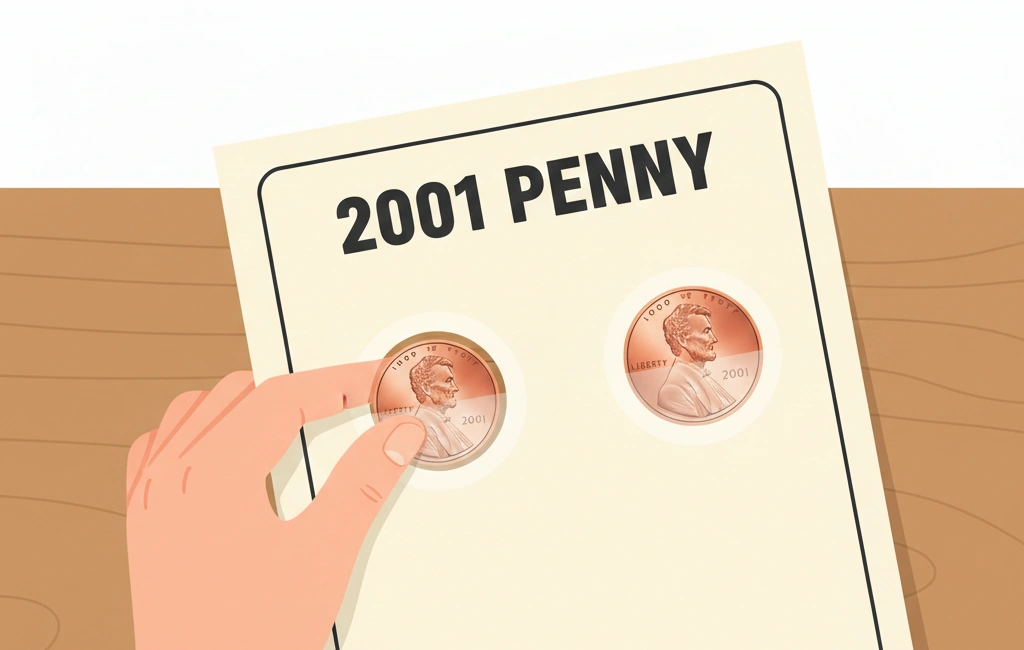
Authenticity and Condition
Evaluating a 2001 cent requires following a specific sequence of actions.
Weight Check: A value of exactly 2.5 g confirms the use of a zinc planchet.
Lettering Examination: Absence of "mushiness" in the font indicates an early die state.
Cleaning Detection: Micro-scratches visible under 20x magnification nullify numismatic value.
Blister Analysis: Large zinc blisters in critical areas reduce the grade by 2–3 points.
Identifying organic contaminants causing future corrosion involves using ultraviolet light.
Mathematical modeling of market data indicates several probable changes.
Moderate price growth for Philadelphia MS68 RD is expected resulting from a shortage of flawless surfaces.
Forecasted growth for MS69 RD prices amounts to 5.5% annually assuming current demand for modern coins persists.
The Denver coin market will remain stable due to a high supply of quality specimens from bank rolls.
Liquidity of uncertified 2001 coins remains negligible, equaling face value.
Bank Rolls and Mint Sets
Banks received a record number of coins in 2001, with some remaining in unopened rolls.
These rolls serve as sources for new grading candidates, though quality often remains low due to coin-to-coin friction.
Coins from official 2001 Mint Sets show superior results regarding field preservation.
Packaging in these sets, however, occasionally causes "haze" on the copper coating, reducing its luster.
Safe removal of coins from sets requires specialized tools to prevent rim damage.
Auction Records
Confirmed top sales for 2001 include the following positions.
2001-P MS69 RD (PCGS): Sold for $4,320 (Heritage Auctions).
2001-D MS69 RD (PCGS): Sold for $646 (GreatCollections).
2001-S PR70 DCAM (PCGS): Sold for $345 (eBay).
2001-P Off-Center 60%: Sold for $135 (Heritage Auctions).
Statistical analysis confirms that 96% of deals for coins in MS68 and higher grades occur through auction platforms.
Conclusion
The 2001 cent represents a complex object for numismatic analysis due to the high probability of hidden plating defects.
Low costs for common specimens contrast with high prices for MS69 coins resulting from the rarity of flawless zinc planchets.
Long-term preservation of these coins requires strict temperature control and an absence of humidity.
Investors are advised to rely on proven population report data for decision-making.
Confirmed facts indicate continued high interest in top-grade 2001 coins throughout the next decade.